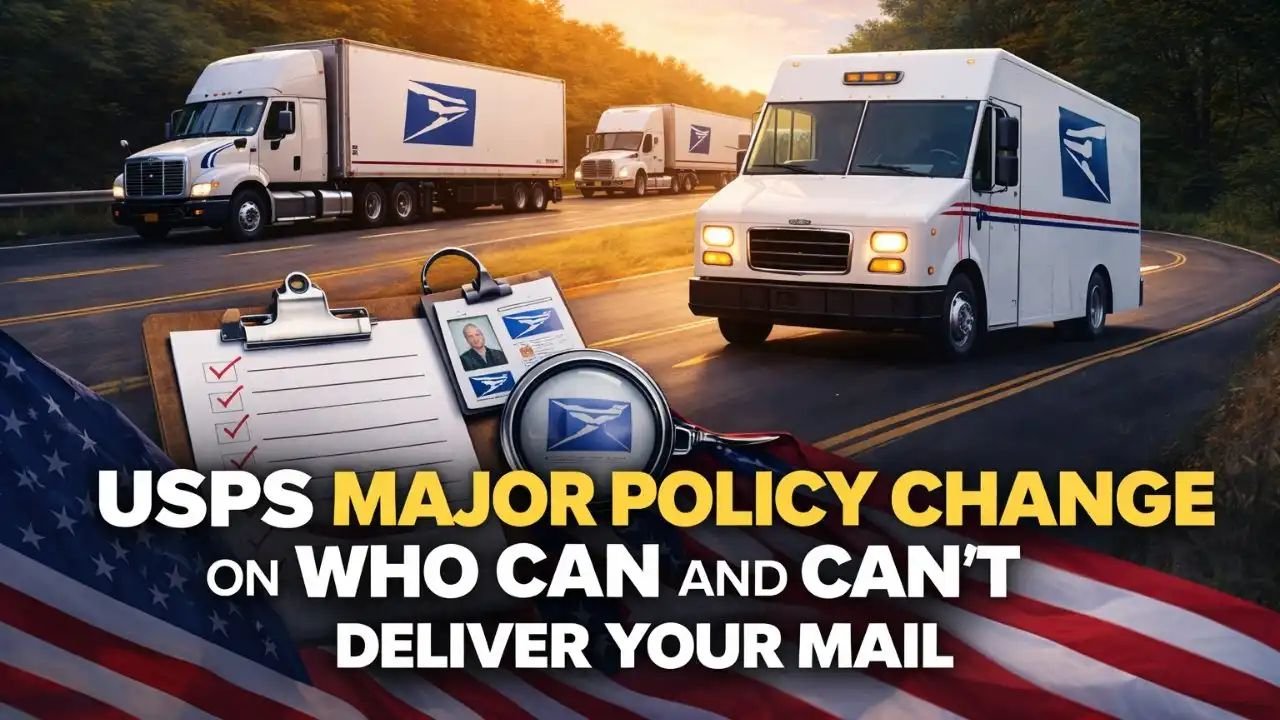
The United States Postal Service (USPS) has announced new rules for who can transport mail across its national network. Effective in early 2026, the policy focuses on contracted truck drivers holding non-domiciled commercial driver’s licenses (CDLs)—licenses issued by states where the driver does not primarily reside.
USPS says the move is part of a broader push for safety, accountability, and operational consistency across one of the largest civilian logistics systems in the United States.
What’s Changing for Contracted Drivers
New Eligibility Standards

Previously, USPS contractors could hire drivers with valid non-domiciled CDLs without additional federal review. The updated policy now requires:
- Enhanced vetting by the Postal Inspection Service
- Verification of identity and legal work authorization
- Confirmation of valid CDL credentials and licensing history
- Review of compliance with federal motor carrier safety regulations
Drivers who fail to complete or pass the vetting process will no longer be eligible to transport USPS mail.
What “Non-Domiciled CDL” Means
A non-domiciled CDL is issued by a state where the driver does not permanently live. This often occurs in interstate trucking, where drivers frequently move or work across state lines. While legally recognized, these licenses present challenges for verifying residency, work history, and compliance records.
Why USPS Made the Change

Safety and accountability are at the heart of this policy shift. Mail trucks travel nearly 2 billion miles annually, moving around 55,000 truckloads daily. Ensuring all drivers meet consistent federal standards reduces risk and strengthens oversight, protecting:
- USPS employees
- Customers
- The general public
The Postal Service emphasizes that this policy is about enhancing safety, not restricting labor unnecessarily.
Implementation and Rollout
USPS will implement the new rules gradually, allowing contractors to adjust staffing and compliance procedures. Mail delivery for the public is not expected to be disrupted, as the phased approach gives trucking partners time to meet the new requirements.
Immediate Impacts
| Stakeholder | Expected Effect |
|---|---|
| USPS contractors | Must verify driver eligibility through federal vetting |
| Non-domiciled CDL holders | Eligibility depends on passing new vetting process |
| USPS employees | No change |
| Mail customers | Service continuity maintained |
Key Takeaways for Contractors and Drivers
- Non-domiciled CDL drivers can still work if they pass the Postal Inspection Service vetting.
- Drivers and contractors should update records and comply with federal checks.
- Local USPS carriers and in-house employees are not affected.
FAQs
What exactly has changed in USPS delivery policy?
Contracted trucking companies must phase out non-domiciled CDL holders unless they pass enhanced federal vetting.
Does this affect regular mail carriers?
No. Career USPS employees and neighborhood letter carriers are not impacted.
Will this cause mail delays?
No. USPS has planned a gradual rollout to prevent service disruptions.
Why focus on non-domiciled CDL holders?
USPS cited safety and verification challenges, including difficulties confirming residency and licensing history.
Can non-domiciled CDL drivers still work for USPS?
Yes, but only if they successfully complete the enhanced vetting process.
Conclusion
USPS’s updated driver eligibility rules reflect a strategic move to enhance safety and compliance across its massive transportation network. While primarily affecting contractors and certain CDL holders, the phased rollout ensures that mail service remains reliable for customers nationwide. Contractors and drivers should prepare now to meet these requirements, while the public can expect no interruptions in daily mail delivery.